Engineering Tomorrow / The video series

The next factory
starts with a
better question.

From the factory floor to the AI decision layer. Explore the engineering behind intelligent production.

Explore the series ↓
Engineering TomorrowWatch / Learn / Build
Engineer · Researcher · Creator

Engineering tomorrow
starts with curiosity.

I’m Nevin Diri, a manufacturing engineer exploring how AI, robotics and digital twins can reshape production.

Factory 2030 is my public research journey—from questions and architectural ideas to experiments and practical demonstrations.

I design intelligent manufacturing systems for the age of autonomous production — where AI-driven decision layers, robotics, simulation, and digital continuity converge into the factories of 2030 and beyond.

Digital Transformation Architecture
AI-Driven Production Systems
Robotics & Autonomous Cell Design
Simulation-Led Factory Engineering
Building Lityum Engineering (R&D)
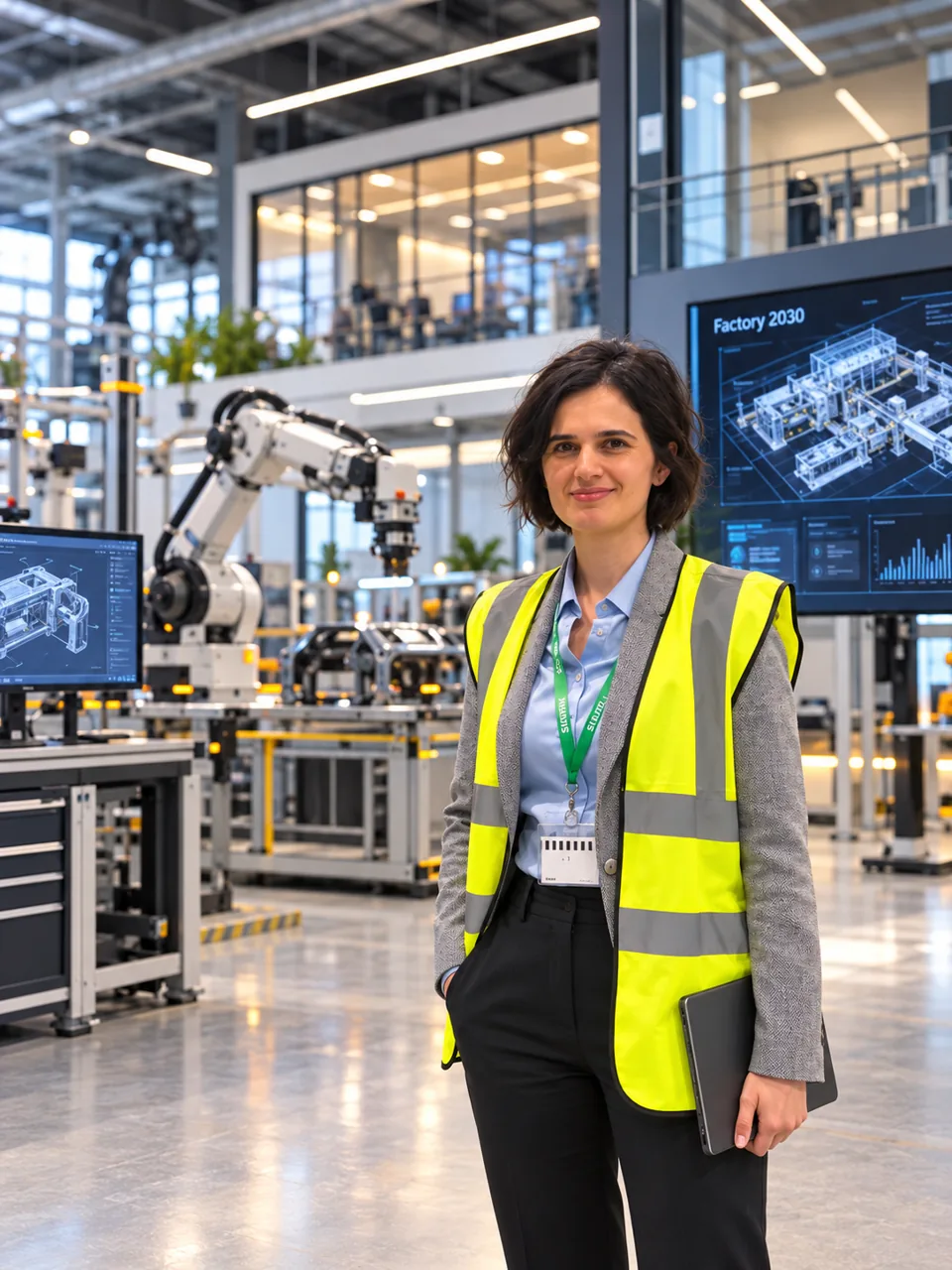
AI-generated portrait of Nevin Diri holding a tablet in a conceptual manufacturing environment.
AI-generated portrait of Nevin Diri in a conceptual Factory 2030 environment.
Focus Areas
Industry 4.0 Digital Twins Autonomous Production IIoT Architecture AI in Manufacturing Robotics Integration Simulation-Led Design Factory 2030 Smart Logistics Cyber-Physical Systems

AI in manufacturing.
Beyond the headlines.

Manufacturing AI news and research, with an engineering perspective on what to evaluate before taking ideas onto the factory floor.

Edition 02 · Reviewed

November briefing · Three recent developments, followed by three background Field Notes.

News / Vendor announcement ·

Gripper engineering is becoming an agent workflow.

Siemens describes a demonstrator with AGIBOT in which an AI agent coordinates gripper selection, geometry adaptation, simulation and preparation for additive manufacturing. A connected adaptive production cell is described as a next step.

Stage: Demonstrated engineering workflow; production-cell extension planned.

Engineering perspectiveEvaluate the complete chain: requirements, tool permissions, geometry checks, virtual validation and manufacturing constraints. A prompt-driven demonstration alone does not establish a production-ready process.

Read the Siemens announcement ↗

News / Research programme update ·

Manufacturing AI needs a verification framework.

NIST’s manufacturing intelligence programme sets out research on human-machine teaming, contextualized data, integration test benches and digital-twin-based assurance. Its plan includes methods for verification, validation and uncertainty quantification.

Stage: Ongoing research programme; planned outputs are not completed standards.

Engineering perspectiveBefore moving a pilot into production, ask who owns each decision, which data gives it context and how model limitations will be measured. Treat the research agenda as a guide to evaluation questions.

Explore the NIST research programme ↗

News / Vendor research & tools ·

Robot learning is moving toward precision work.

At CoRL, NVIDIA introduced GR00T 2, Isaac Lab 3.0 and partner benchmarks focused on robot learning and manipulation. Its report describes simulation-based work on tasks such as component alignment, cable handling and assembly.

Stage: Research and development tools; suitability must be validated for each industrial task.

Engineering perspectiveLook beyond a successful demonstration. Test task variation, contact behaviour, failure recovery and transfer from simulation to the physical cell before drawing conclusions about reliability.

Read NVIDIA’s CoRL update ↗

01 / Research roadmap · 03 Jul 2026

The bottleneck is the system around the model.

NIST’s 2026 smart manufacturing AI roadmap identifies data management, integration across sensing and control, and reliable operation as deployment challenges alongside the models themselves.

Engineering perspectiveDefine the production decision, data owner and fallback first. Evaluate a model against an operational baseline, not just an offline accuracy score.

Read the NIST roadmap ↗

02 / Industry report · 19 Oct 2026

Planning agents need a proving ground.

NVIDIA reports that Siemens’ Erlangen factory is exploring planning agents that compare production options and test changes in a digital twin, with a production controller approving the plan.

Engineering perspectiveA useful agent proposes a bounded decision with visible trade-offs. Before connecting one to planning software, define approval rights, simulation checks and a reversible execution path.

Read NVIDIA’s factory report ↗

03 / Research programme · Reviewed 20 Oct 2026

Trustworthy production AI starts with measurement.

NIST’s AIMS programme combines measurement, physics-based models and AI to monitor manufacturing machines. It emphasizes machine-specific validation and periodic model verification.

Engineering perspectiveFor a quality or maintenance pilot, define sensor uncertainty, false-alarm cost and the conditions that trigger a model review before scaling.

Explore NIST AIMS ↗

A curated reading desk, not a live news feed. Source summaries describe published work; engineering perspectives are editorial interpretation. Dates distinguish publication from source updates. Vendor announcements and research programmes are labelled, and development stages are stated for the November briefing.

The Intelligent Factory Thesis

A long-term architectural perspective on where manufacturing systems are heading — and what it takes to design them.

The factory of 2030 is not a faster version of today's factory.
It is a fundamentally different class of system.

Most industrial transformation efforts are optimizations — lean tools with digital labels, ERP migrations dressed as innovation. They make today's processes marginally faster or slightly more visible. That is not what I work toward.

The shift I'm designing for is architectural: from human-operated, experience-driven factories to self-organizing, AI-governed production environments where physical systems, digital representations, and decision intelligence operate as a unified whole.

This requires rethinking the factory not as a collection of machines and workflows, but as a cyber-physical system — one where simulation precedes physical action, where AI continuously optimizes against real constraints, and where robotics operates not as isolated automation but as an integrated production layer.

My work sits at the intersection of systems architecture, manufacturing engineering, and emerging production intelligence. I'm building the thinking, the frameworks, and eventually the platforms to make this transition navigable for industrial companies.

PILLAR 01
Simulation Before Steel
Every production decision should be validated in simulation before physical execution. Continuous digital twins eliminate the trial-and-error cycle that drives waste and downtime.
PILLAR 02
AI as Production Operating System
AI is not a reporting tool or an anomaly detector. In the 2030 factory, it is the decision layer — continuously optimizing scheduling, quality, logistics, and maintenance in real time.
PILLAR 03
Robotics as First-Class Infrastructure
Robotic systems should be designed into factory architecture from day one — not retrofitted. Collaborative, mobile, and adaptive robotics form the physical execution layer of intelligent factories.
PILLAR 04
Data Continuity Across the Value Chain
Intelligent production requires unbroken data continuity — from raw material to shipped product. Fragmented systems are the single biggest architectural failure in modern manufacturing.

Factory 2030 Architecture

A layered systems model for designing intelligent, autonomous manufacturing environments — from physical production to cognitive control.

From concept to operation / New detailed guide

Build the whole system, from the ground up.

Explore 24 engineering domains, 192 design checks and six delivery gates—from foundations, electricity and cabling to factory layout, computing, production workflows and AI.

The three-layer view below remains a conceptual overview. The full guide organizes the engineering work, deliverables, discipline ownership and coordination needed for a greenfield discrete-manufacturing factory.

Explore the full architecture →
LAYER 01 — PHYSICAL
⚙️
Production Systems
The physical foundation — machines, cells, assembly lines, and material flows. Designed for sensor density, modularity, and robotic integration from the outset.
CNC, AMRs, Cobots
Sensor Networks (OPC-UA, MQTT)
Modular Cell Architecture
Real-Time Data Acquisition
LAYER 02 — DIGITAL
🔮
Digital Continuity
The mirrored layer — live digital twins, simulation environments, and production models that run in parallel with physical operations and enable predictive action.
Digital Twin Architecture
Process Simulation (DES, FEA)
Virtual Commissioning
Product Lifecycle Management
LAYER 03 — COGNITIVE
🧠
Intelligence & Control
The decision layer — AI models, optimization engines, and autonomous control systems that govern production scheduling, quality, maintenance, and logistics in real time.
Predictive Maintenance AI
Autonomous Scheduling
Vision-Based Quality Systems
Adaptive Production Control
Factory 2030 / System perspective

From physical production
to intelligent control.

The architectural reference connects production equipment, digital models, AI decision-making and autonomous control. Explore the research questions behind these connections.

Explore research & experiments →
factory_architecture.sys
architect Nevin Diri
domain Intelligent Manufacturing
horizon 2030+
layer_01 Physical Production
layer_02 Digital Twin / Sim
layer_03 AI Decision Engine
layer_04 Autonomous Control
robotics integrated
simulation continuous
ai_layer active
System Online
lityum_eng.v1
Connectivity & Data
OPC-UA MQTT SCADA Historian Edge Computing Cloud IIoT Time-Series DB
Simulation & Digital Twin
Plant Simulation Tecnomatix AnyLogic Ansys Twin Builder Unity MARS NVIDIA Omniverse
AI & Analytics
Predictive ML Computer Vision LLM Integration Reinforcement Learning Python / PyTorch Azure ML
Manufacturing Systems
MES ERP Integration WMS QMS CMMS PLM

Research & Experiments

Active areas of investigation — from conceptual frameworks to working prototypes and product ideas in the intelligent manufacturing space.

R–01
Lightweight Digital Twin Framework for Discrete Manufacturers
Most digital twin implementations are enterprise-scale projects requiring 12–18 months and significant infrastructure. This research explores a minimal viable twin architecture — what's the least a mid-market manufacturer needs to gain real operational insight from a live production model?
Digital Twin System Architecture SME Manufacturing OPC-UA
Active
R–02
AI Scheduling Agent for Job Shop Environments
Job shops face a combinatorially complex scheduling problem — dynamic order intake, varying machine capacities, and unpredictable lead times. Investigating the application of reinforcement learning-based scheduling agents as an alternative to rule-based MES scheduling engines.
Reinforcement Learning Production Scheduling Job Shop MES
In Design
R–03
Autonomous Cell Architecture: Designing for Reconfigurability
Fixed-layout production cells are a liability in volatile demand environments. This work develops a design methodology for reconfigurable manufacturing cells — parameterizing the tradeoffs between capital cost, flexibility, and throughput in cobot-integrated environments.
Robotics Cell Design Cobots Reconfigurable Manufacturing
Active
R–04
LLM-Assisted Process FMEA Generation
Failure Mode and Effects Analysis is foundational to manufacturing quality systems but is time-intensive and highly dependent on experienced engineers. Exploring whether LLMs, grounded in process and product data, can generate credible initial FMEA documentation as a structured starting point for engineering review.
LLM Quality Systems FMEA AI Tooling
Conceptual
R–05
Engineering Tomorrow — Manufacturing Intelligence Channel
A YouTube channel and content platform documenting the architecture, systems thinking, and technology landscape behind intelligent manufacturing. Building a long-form reference for engineers, operators, and industrial leaders navigating the shift to Factory 2030.
YouTube Industry 4.0 Education Manufacturing Intelligence
Active
E–01
Factory 2030: A Layered Architecture
A structural essay on how intelligent factories should be designed — not as upgraded versions of today's plants, but as layered cyber-physical systems where the physical, digital, and cognitive layers are co-designed from the ground up. Covers the four-layer model and its implications for technology selection, integration strategy, and organizational design.
Essay Factory Architecture Systems Design Industry 4.0
Writing
E–02
Simulation Before Steel: Why It Matters
The manufacturing industry has accepted trial-and-error as a normal cost of production — both during factory commissioning and during ongoing operations. This essay argues for a simulation-first discipline: the practice of validating every significant production decision in a digital environment before physical execution, and what that requires architecturally.
Essay Simulation Digital Twin Engineering Methodology
Writing

The 2030 Factory — Built from Scratch

A ground-up engineering series covering every layer of an intelligent factory — from the concrete floor to the AI decision layer. No shortcuts, no buzzwords.

What this series covers
Most Industry 4.0 content skips the fundamentals. This series doesn't. We start where every factory starts — the physical floor — and build upward through power infrastructure, production lines, robotics, connectivity, digital twins, and AI. Each episode is a complete engineering reference for one layer of the 2030 factory stack.
01
Published
02
Coming Soon
Season 01
EP 01
The Floor — Foundation of Everything
Industrial floor materials, load capacity, vibration isolation, drainage, cable channels, and why most factories get this wrong from day one.
Published
Watch episode →
Season 01
EP 02
The Building — Designing for Intelligence
Ceiling height, thermal management, natural light, structural flexibility, and how to future-proof a building for robotics and automation expansion.
Coming Soon
Season 01
EP 03
Power Infrastructure — Electricity for 2030
3-phase setup, UPS systems, energy monitoring, load planning for robotics, and solar integration in industrial environments.
Coming Soon

System Capabilities

The engineering disciplines and system design competencies that form the foundation of this work.

🏗️
Digital Transformation Architecture
Designing the structural roadmap for manufacturing organizations transitioning from legacy, siloed operations to integrated, data-driven production environments. This is systems design work — not change management consulting.
🔮
Digital Twin Design & Implementation
Scoping, designing, and deploying live production models that mirror physical factory behavior in real time. From sensor architecture and data pipelines to simulation environments and predictive analytics on top of twin data.
🤖
Robotics & Autonomous Systems Integration
Architecting robotic cells and autonomous material handling systems as integrated production infrastructure — not isolated automation islands. Cobot deployment, AMR path design, and safety architecture included.
🧠
AI-Driven Production Intelligence
Designing and deploying AI applications across the production stack: predictive maintenance models, vision-based quality inspection, demand-responsive scheduling, and energy optimization systems.
⚡
Factory Simulation & Virtual Commissioning
Using discrete-event simulation and 3D virtual environments to validate factory layouts, throughput capacity, and robotic cell behavior before physical deployment — eliminating costly physical trial runs.
📡
IIoT Architecture & Data Infrastructure
Designing the connectivity layer of intelligent factories — OPC-UA / MQTT integration, edge computing nodes, historian databases, and real-time data pipelines that feed both operational dashboards and AI models.

Nevin Diri

Manufacturing Systems Architect. Working at the intersection of industrial engineering, production intelligence, and factory systems design.

nevin_diri.profile
roleManufacturing Systems Architect
backgroundManufacturing Engineering
focusFactory 2030 / Intelligent Production
companyLityum Engineering (Founder)
programEngineering Tomorrow
linkedin/in/nevindiri
orientationLong-term / Research-driven

I'm a Manufacturing Engineer working at the intersection of industrial systems, digital architecture, and production intelligence. My focus is not incremental digitization or isolated automation — it is the architectural evolution of how factories are designed, integrated, and governed.

At their core, factories are not only mechanical systems — they are information systems embodied in physical infrastructure. Sensors generate signals. Machines respond to control inputs. Data moves across networks with latency, noise, and constraints. Performance is shaped by how effectively information is generated, transmitted, and acted upon across the production stack.

Across my experience in manufacturing, I've observed a consistent gap: the systems thinking required to design truly intelligent factories rarely exists in engineering or technology domains alone. Intelligent production demands reasoning across layers — from sensor networks and robotics control to simulation environments, AI decision models, and operating workflows.

This site documents my ongoing work in developing those architectural perspectives. Through Lityum Engineering, I explore and prototype models for intelligent manufacturing systems — translating long-term systems thinking into applied engineering practice, and ultimately into scalable industrial platforms.

Systems Architecture
Digital Twin Engineering
AI in Production
Robotics Integration
Factory Simulation
IIoT Infrastructure
Process Engineering
MES / ERP Architecture
Cyber-Physical Systems

Considering AI for a manufacturing process?

Explore a focused assessment of one use case: the production decision, available data, integration constraints, and the evidence needed before proceeding.

Manufacturing AI / Use-case assessment

A practical starting point for one decision.

For manufacturing teams evaluating an AI idea or working through a pilot that has stalled. We start with the operational question and what success would mean in your process.

  • Decision & baselineDefine the decision to support, who owns it, and the current performance to compare against.
  • Data & integrationReview the available data, its ownership and quality, and the path between existing systems and the proposed use case.
  • Operational boundariesIdentify approval responsibilities, fallback arrangements, and the checks needed before any production trial.

Factory 2030 remains my central research initiative. This focused engagement sits alongside the public research, Field Notes and Engineering Tomorrow series. Explore the research →

// Discuss the Future of Manufacturing

Let's build
what's next.

The factory of 2030 won't be designed by any single discipline. If you're an engineer, researcher, founder, or industrial leader thinking seriously about intelligent production systems — I'm interested in the conversation.

Whether it's a specific architectural challenge, a research collaboration, or an early-stage venture in the manufacturing intelligence space — reach out.

Via
Lityum Engineering
A research and applied engineering practice focused on intelligent manufacturing systems — working at the boundary between industrial engineering and the technologies that will define Factory 2030.
Open to discussing